Flooring is often thought of purely as a structural foundation, a surface meant to endure heavy foot traffic, pets, and dropped cookware. For decades, the default approach in residential design has been simplicity: straight-lay wood planks running parallel to the longest wall or large-format ceramic squares laid in a standard grid. While these selections provide a clean look, they frequently leave a room feeling flat and uninspired.
Flooring has now become a major design focus. Homeowners, builders, and designers increasingly view floors as an open canvas capable of establishing movement, architectural pedigree, and spatial rhythm. The pattern in which you lay your flooring materials—whether hardwood, porcelain tile, brick pavers, or luxury vinyl—influences how large a space feels, where natural light travels, and how the entire room balances decorative elements. By stepping away from the standard grid and embracing geometric layouts, you can instantly turn an ordinary surface into an architectural focal point.
The Timeless Elegance of Herringbone and Chevron
Parquet styles have dominated prestigious European estates for centuries, yet they have made a widespread return to modern residential design. While herringbone and chevron are frequently confused with one another, their geometric construction delivers entirely different aesthetics.
Classic Herringbone
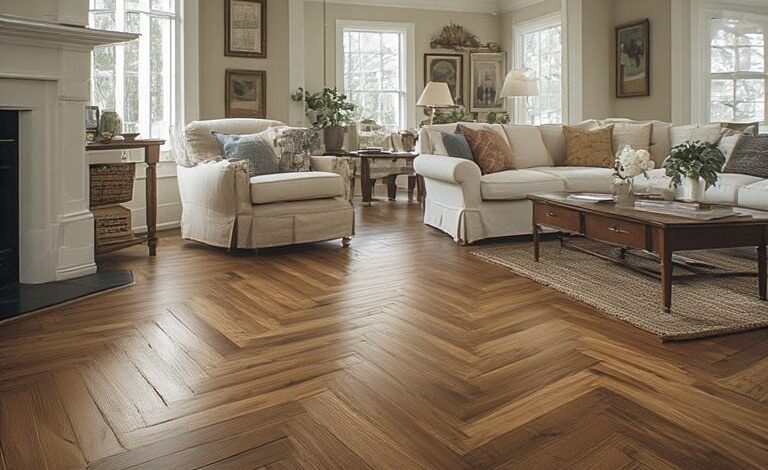
Herringbone is crafted using true rectangular planks laid in an interlocking, alternating zigzag. The short end of one board butts directly against the side edge of another at a ninety-degree angle.
-
Visual Rhythm: The broken zigzag pattern creates an engaging, shifting surface texture that catches natural daylight from varying directions throughout the day.
-
Directional Movement: Herringbone directs the eye forward. It works exceptionally well in narrow hallways, entry foyers, and transitional spaces by visually pulling visitors into the next room.
-
Material Versatility: While historically executed in traditional solid white oak or walnut, modern herringbone patterns look equally refined when built using glazed ceramic subway tiles for a kitchen floor or thin brick veneer in a mudroom.
Crisp Chevron
Chevron delivers a cleaner, more continuous geometric line. Instead of overlapping rectangular boards, chevron planks are precision-cut on both ends at a forty-five or sixty-degree angle. When two boards join together, they form a razor-sharp, unbroken point that resembles a series of arrows.
-
Symmetrical Elegance: The continuous lines of chevron offer a tailored, formal feel that suits Parisian-inspired flats, grand living rooms, and upscale dining areas.
-
Spatial Widening: When installed with the points running across the narrower width of a room, chevron can trick the eye into perceiving a wider floor plan.
-
Precision Craftsmanship: Because every point must align across long spans, chevron requires meticulous subfloor preparation and skilled installation to avoid drift.
Dynamic Geometrics: Basketweave and Parquet de Versailles
If you want a flooring design that immediately conveys craftsmanship and historical character, traditional parquet arrangements offer unmatched complexity.
Classic Basketweave
Basketweave patterns mimic the woven texture of natural fibers, using contrasting rectangular and square tiles to create the optical illusion of interlocking strips of material.
-
Scale Adjustments: Micro-basketweave, commonly executed in polished Carrara marble with contrasting black dot inserts, serves as a staple for vintage-inspired bathrooms. Larger wooden basketweave designs bring warmth and texture into libraries and home offices.
-
Balanced Contrast: Pairing light wood strips with dark corner insets—or combining matte porcelain with tumbled slate—creates subtle depth without needing loud paint colors or busy wallpapers.
-
Tonal Harmony: When installed using a single uniform material without high-contrast inserts, basketweave introduces quiet, touchable texture that softens modern minimalist interiors.
Parquet de Versailles
Originating in the French palace during the seventeenth century, the Versailles pattern consists of large square panels containing intricate, interlaced diagonal wood batons surrounded by an outer wooden frame.
-
Grand Architectural Statements: These expansive square panels work best in spacious, high-ceilinged rooms where the intricate design can breathe without being covered by oversized area rugs.
-
Heirloom Character: Often installed using reclaimed timbers or wire-brushed French oak, this layout brings an unmistakable sense of heritage to both historic restorations and new Mediterranean-style builds.
Bold Visual Contrasts: The Checkered Renaissance
The classic black-and-white checkered floor has remained an icon of classical architecture since ancient times, yet contemporary interior design has reimagined this layout in fresh ways.
Softened Tonal Checkers
The modern iteration of the checkered floor steps away from harsh, high-gloss diner aesthetics in favor of earthy, muted stones and nuanced color palettes.
-
Honed Limestone and Marble: Pairing creamy honed limestone with soft charcoal slate or deep taupe pavers delivers an old-world elegance suitable for sunrooms, laundry rooms, and kitchens.
-
Earthy Terracotta Combos: Alternating raw, unglazed terracotta tiles with hand-painted cream tiles introduces rustic warmth that feels lived-in and organic.
-
Diagonal Diamonds Versus Straight Grids: Installing a checkered pattern at a forty-five-degree angle creates diamond shapes that visually expand the edges of a room, making square rooms appear larger than they are.
Organic Textures: Running Bond and Brick Paver Layouts
For spaces designed around utility, comfort, and heavy traffic, simple masonry patterns grounded in earthy materials offer durability and rich character.
Running Bond and Staggered Offsets
The running bond pattern staggers standard rectangular tiles or bricks so that the joint of one row sits squarely at the midpoint of the row below it.
-
Effortless Casual Style: A standard one-third or one-half running bond layout provides a familiar, grounded feel that does not compete with bold kitchen cabinetry or vibrant upholstery.
-
Irregular Planks: When used with wide-plank hardwood floors, random staggered joints mimic historic farmhouses where boards were milled to varying lengths to minimize material waste.
Double and Triple Herringbone Brick
Mudrooms, pantries, and laundry zones benefit from the rugged texture of authentic clay brick pavers. Grouping pavers in pairs or trios to create double or triple herringbone patterns adds a sturdy, industrial character that hides dirt and wear.
Mixing Materials and Inlay Borders
For a truly custom floor, combining contrasting materials or defining room boundaries with inset borders turns functional flooring into fine art.
-
Wood-to-Tile Transitions: Rather than using straight metal transition strips between an open-concept kitchen and living room, designers allow hexagonal floor tiles to weave organically into straight hardwood planks.
-
Framed Rug Effects: Laying a bold decorative pattern, like an intricate floral cement tile or a dynamic parquet panel, in the center of a dining room while framing the perimeter with straight wood planks mimics the look of a permanent area rug.
-
Inlaid Brass and Metal Details: Thin, unlacquered brass rods inlaid between contrasting marble slabs catch the light and add refined luxury to entryways.
Choosing a patterned floor is an investment in architectural character. Whether you choose the dynamic geometry of herringbone, the visual structure of a muted checkerboard, or the artisan allure of parquet, changing your flooring layout transforms an everyday surface into the defining feature of your interior design.
Frequently Asked Questions
How much extra flooring material should you order when installing a complex pattern like herringbone?
When installing specialized patterns like herringbone, chevron, or diagonal layouts, order fifteen to twenty percent extra material above your calculated square footage. The frequent cuts along the room perimeter, coupled with the need to match points and maintain symmetrical layouts, generate substantially more off-cut waste than a traditional straight-lay installation.
Do intricate flooring patterns make small rooms feel cramped or larger?
When scaled correctly, patterned floors can make small rooms appear significantly larger. Laying patterns diagonally or using chevron pointing outward pushes the viewer gaze toward the walls, creating an optical illusion of greater width and depth. However, choosing patterns that are too dense in a small powder room can overwhelm the space, so choose your pattern scale carefully.
How does installing a patterned floor affect overall project labor costs?
Labor costs for patterned floors are typically thirty to fifty percent higher than standard straight-lay installations. Patterns like chevron and herringbone require precision layout planning, continuous dry-fitting, subfloor leveling, and custom angled cuts along every wall edge, which substantially increases installation time.
Can luxury vinyl plank or laminate flooring be installed in a herringbone pattern?
Only specifically engineered luxury vinyl or laminate planks can be installed in a herringbone pattern. Standard tongue-and-groove or click-lock planks feature fixed locking profiles designed only for parallel, linear joining. To build a herringbone floor with vinyl or laminate, you must purchase manufacturer-designated planks produced with alternating right-facing and left-facing locking mechanisms or opt for glue-down commercial-grade planks.
What is the best way to clean and maintain patterned tile floors with extensive grout lines?
Floors with intricate patterns, such as small-format basketweave or hexagonal layouts, feature significantly more grout lines that can collect dirt and moisture. To protect them, apply a commercial-grade penetrating grout sealer immediately after installation and reapply it every one to two years. Use a pH-neutral cleaner and a microfiber mop for regular maintenance, avoiding harsh acidic detergents that can erode the grout matrix over time.
Which baseboard and trim styles pair best with bold patterned flooring?
Simple, tailored baseboards with clean profiles, like a classic flat-stock baseboard with a subtle eased edge, pair best with busy, patterned floors. Overly detailed baseboards with deep decorative fluting can visually clash with the geometry of the floor, creating aesthetic competition along the perimeter of the room.
How do you choose the right grout color for geometric patterned tile?
Choosing a grout color comes down to whether you want high contrast or subtle texture. Selecting a grout color that sharply contrasts with your tile highlights the geometric shape of every individual piece, making the layout the central design feature. Choosing a matching grout color softens the pattern, resulting in a cohesive, textured surface that lets other room furnishings take center stage.